
Screw conveyors or auger conveyors use a rotating helical screw blade to move bulk materials. They are often utilized in bulk handling industries such as the food, chemical, and pharmaceutical industries. Screw conveyors are horizontal, vertical, or inclined, and they are used to move a variety of materials, including powders, granules, and liquids.

Sodimate’s CS screw conveyor system is designed to transport sludge material between two points without altering feed accuracy or damaging product particles. It is also known as an auger screw conveyor.

Sodimate’s flexible screw conveyors are shaftless (”pigtail”) and can easily be bent through a pliable pipe (UMHW) to access difficult-to-reach places. This simple screw conveyor design reduces maintenance operation while providing highly efficient performance. The size and length of the screw conveyor system are selected according to the type of material to be conveyed, and standard length ranges from 1-60 ft. These flexible screw conveyors can extend up to 100ft and can be installed at any inclination angle from horizontal to vertical.
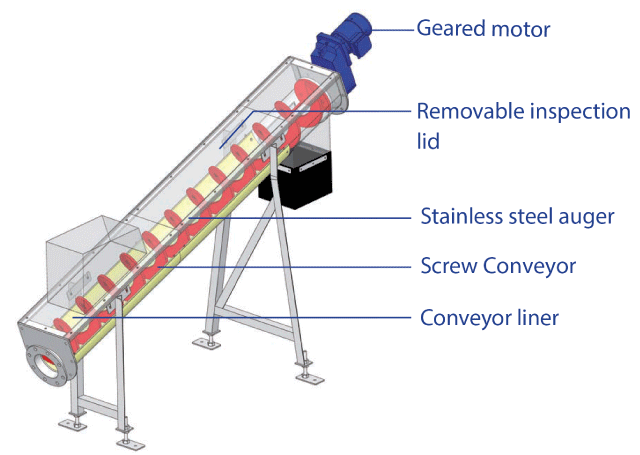
Screw Conveyor

Screw Conveyor Design and Installation

Screw Conveyor
Screw Conveyor

The screw conveyors or auger conveyors are often used to transport sludge and grit and are designed to be paired with Sodimate’s MBV sludge mixer. They can also be used to collect grit from slakers, classi­fiers and screens.

The use of a shaftless spiral in a screw conveyor system allows naturally sticky mud to enter easily and eliminates the need for bearings. To protect the stainless-steel trough and extend its life, the spiral rotates on a wear coating (or liner). Sodimate offers a bolt fixing method for long rotors delivered in numerous portions (> 11 m) that eliminates the need for on-site welding.

The flexible screw conveyors can be inclined vertically, with draining outlets, sample taking, numerous exits with pneumatic valves, and motorized rotation for improved distribution in the storage area or bin. Each CS screw conveyor is custom-built to meet the requirements of the application (dry solids percent, flow rate, length, angle, type of sludge, etc.). From the lime storage silo to the sludge storage area, Sodimate’s design department can create a full sludge stabilization unit.